Category: Reviews

  • Paulina Tarot Sneak Peek Preview of a Deck Now Published

    Paulina Tarot Sneak Peek Preview of a Deck Now Published

    Tarot World Magazine
    Sneak Peek
    Paulina Tarot
    U. S. Games System Inc.
    Christiana Gaudet

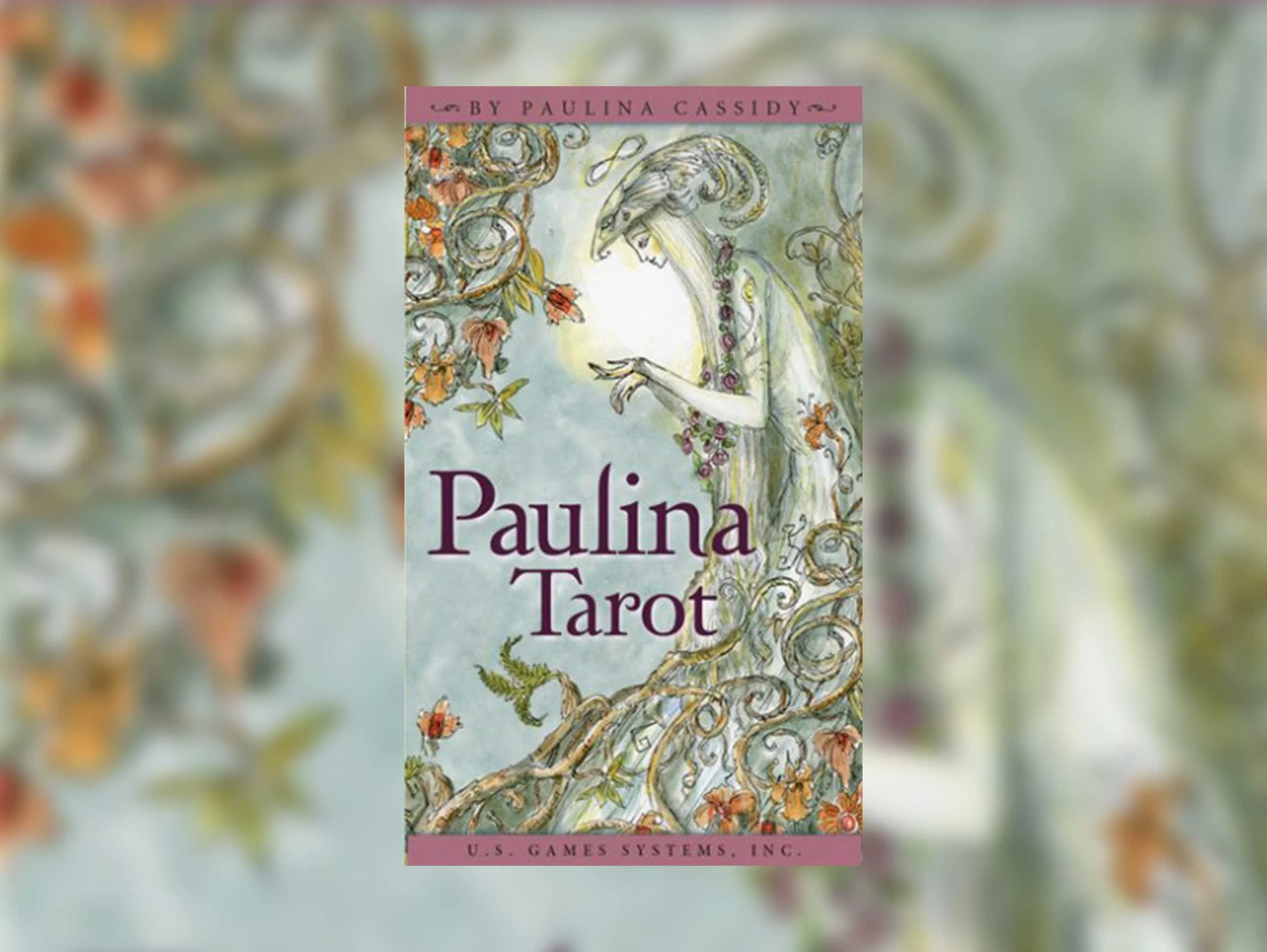
    Artist Paulina Cassidy has made it easy for us to get a sneak peak at her forthcoming Tarot Deck, Paulina Tarot. Her website, Restless Moon Gallery, has digital images of all 78 cards. Her darkly whimsical drawings made me curious about this soon-to-be-published Tarot, and so I had a conversation with Paulina Cassidy on the phone from her home in Chattanooga, Tennessee. We talked about Tarot, art, and this exciting new deck.

    Paulina Cassidy can’t remember a time when she wasn’t an artist. From the time she was a toddler, she had only one choice for a profession. As a young adult working under her maiden name, Paulina Stuckey, she began writing, illustrating and self-publishing storybooks and creating art prints that feature fanciful characters. With the launch of her website in 1999, she developed a world wide clientele.

    When Cassidy speaks of the creation of Paulina Tarot, it feels like a truly magickal experience. Cassidy says that she had no real theme in mind when she began designing the deck. In fact, the deck began as a study tool. While she had been interested in the Tarot for many years, she began the fifteen-month project with only a rudimentary knowledge of the cards. “The process of me learning the Tarot was for me to actually create each card.” She told me. “I’d focus on one card at a time, and interestingly enough, when I’d choose a card (I didn’t actually do them in sequence) it felt like it corresponded with an important event or turning point in my life, and then that card became a guiding point.”

    Cassidy told me that as she let her subconscious mind guide the design of the cards, the images that resulted were closer to the traditional images and meanings than she had realized or planned. One of the cards Cassidy struggled with was the Five of Wands. “I think I created four or five different images for that one.” It’s no surprise that a card that speaks of conflict might create conflict in its creation!

    Cassidy’s primary medium is watercolor and ink. Her work is reminiscent of Tim Burton, Dr. Seuss, and Edward Gorey, three artists that she counts amongst her influences. “But it’s not just art that influences me,” she says. “It’s music, it’s places, it’s a combination of so many elements that affect us and create the style that we have.”

    One of the places that clearly shows its influence in Paulina Tarot is New Orleans. Paulina and her husband lived there until 2007, and it was there that work on Paulina Tarot was begun. Many of the characters in the deck are dressed for masquerade, and there is a “Mardi Gras feel” to some of the cards. Harlequins and ballerinas dance their way through the deck. Sweet-faced girls wear magnificent ball gowns with intricate patterns. There are people with wings, and people riding on large birds. There are mythical creatures such as unicorns and mermaids. There are animals such as the world has never seen, like a flying lion, and a cat with the tongue of a snake. When I asked Cassidy who these creatures were and what they meant, she said, “I really don’t know- I wish they’d introduce themselves to me.” Cassidy says that her creatures do talk, “according to people who can hear them.” She says that she can only sense them. “I’ll be sitting there and suddenly something’s hilarious, and I don’t know what it is but I have to run to the drawing board and draw it.” Cassidy says her Tarot is peopled with creatures from her own subconscious, who “found out I was working on this Tarot deck and said ‘Hey, I want to be a part of this!’”

    But lest you decide that this deck lacks true symbolism, or is simply an “Art Tarot,” take a deeper look at the cards. You’ll see the Devil, who has enslaved himself. Look at the Queen of Cups, whose gown is the ocean. While each element of each image does not always have a symbolic meaning, each card as a whole does speak its traditional meaning quite clearly.

    Many of the characters are in poses similar to their Rider Waite Smith counterparts. Like many of us, the trusty deck in the yellow box was Cassidy’s first. As visually different as Paulina Tarot is, it still sticks to the basic RWS conventions. There are some obvious breaks from the familiar, but none that are out of the ordinary for a modern deck. The Magician and the Hermit are both female, for instance, but their poses and interpretations remain traditional.

    As we closed our conversation, I asked Paulina Cassidy to speak directly to the many Tarot readers who will be purchasing her deck. “Just have fun with it,” she said. “Let yourself be amused and entertained and moved by what you see. That means the world to me.”

    Paulina Tarot will be released by U.S. Games sometime this year. It will be a standard size, and packaged with an LWB written by Paulina Cassidy. Until the deck is available, we can admire it at Restless Moon Gallery, http://www.paulina.ws.

    Please visit Paulina Fae’s website for more information!

    (Note 9/7/24: The link to Restless Moon Gallery wasn’t working. The link to Paulina Fae website was added.)
  • Medieval Cat Tarot Review

    Medieval Cat Tarot Review

    Tarot World Magazine
    Tarot Deck Review
    January 2008 Edition
    Medieval Cat Tarot
    By Lawrence Teng
    Review by Christiana Gaudet
    Copyright © 2007

    Unlike many of my Tarot friends, I don’t go to renaissance faires and I don’t have cats. And so I might have entirely missed the Tarot gem that is Medieval Cat Tarot if it weren’t for two things.   First, a Tarot student told me that her readings improved after she started working with this deck. Then, I discovered that the Little White Book is co-authored by Gina M. Pace, author of the Pagan Tarot. I couldn’t imagine that either my student or Gina Pace would embrace a trite deck. And, as it turns out, they didn’t! Medieval Cat Tarot has enough beauty, mysticism, humor and all-over-good-Tarot-vibes to excite me, even though I usually shy away from cute decks that show animals in costume.

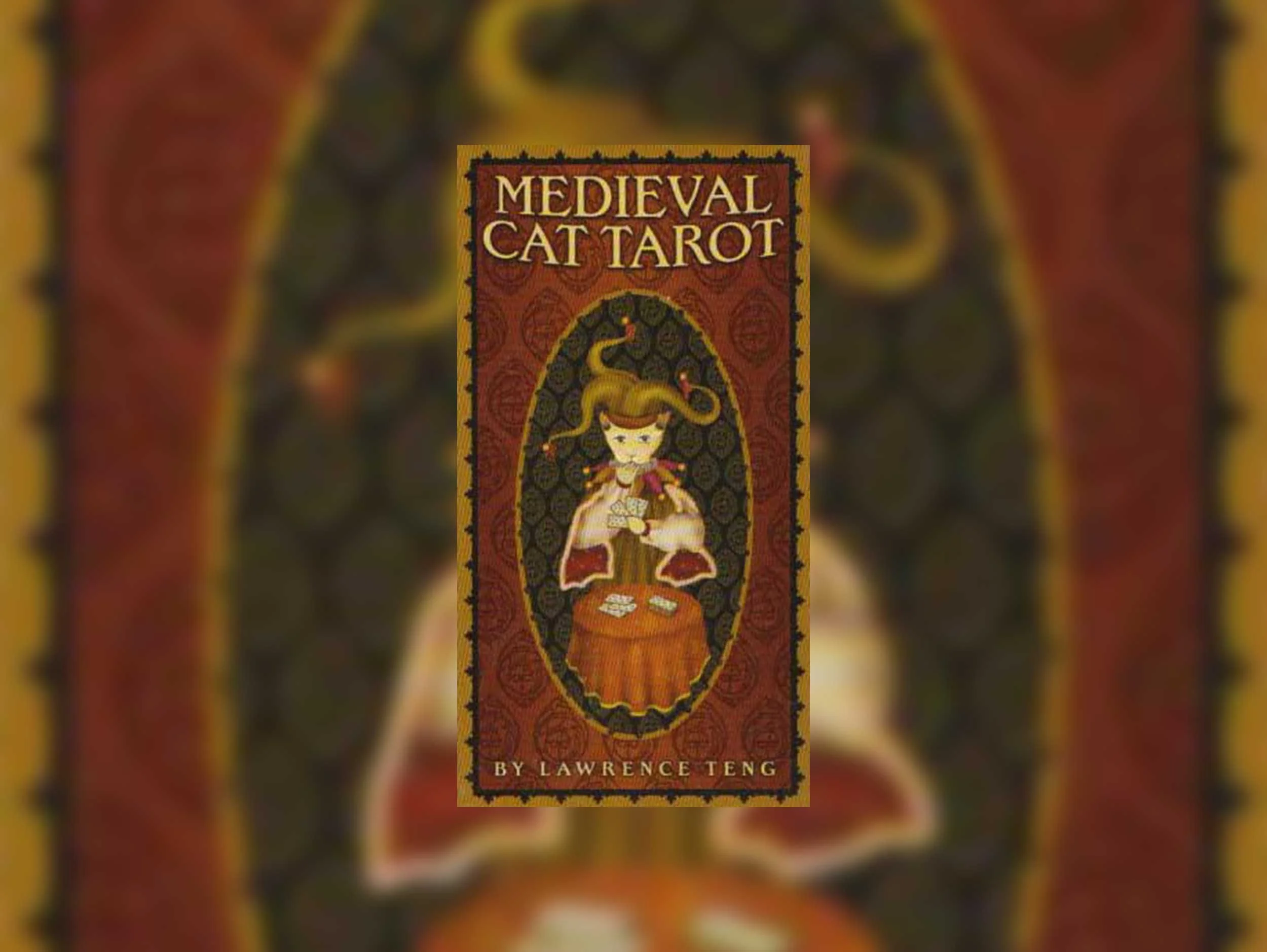
    Medieval Cat Tarot is published by U.S. Games, and was released in 2004. At 4 ½” by 2 1/2” the cards are noticeably more narrow than most. Somehow, this adds to the medieval feel of the deck. The coloring, too, is a huge part of the deck’s personality. Both back and front of the cards are covered with flourishes in shades of brown, gold and yellow. Rather than looking dull or dark, it looks royal and antique.

    The quality of the deck is standard for U.S. Games, the card finish is glossy and the deck comes in the old packaging format with just the Little White Book. Gina M. Pace, along with Tarot artist Lawrence Teng, has written an LWB worth reading. It’s a lot of good information in a small space, and certainly suitable for a beginner.

    One of the most interesting aspects of this deck, other than its peculiar subject matter, is that the pips are designed in the Marseilles style, where each card shows simply the appropriate number of suit icons. But in the center of each card is an oval, with a picture of a cat in action. Thus, the Medieval Cat Tarot has achieved something that many other decks have tried to do less successfully. It has combined the meditative and intuitive grace of the Marseilles style with the artistry and vision of the Waite style.

    These little cat pictures remind me of windows into another world; a world where cats walk upright and wear elaborate medieval garb. The pictures are simple, but with interesting detail and symbolism. Once again, the use of color is stunning. Spots of blue, red and yellow simply shine against the dark background.

    Many of the cats are shown in basic Waite-style poses. Some of them, however, portray the Waite ideas but make specific reference to cat life. For instance, the Five of Coins shows a sad kitty stuck in a tree in the rain. The Seven of Swords shows the cat who (you guessed it!) ate the canary. 

    The Court ranks are traditionally named. Of the Court cards, the Kings are my favorite. The King of Swords sits in front of a windmill. The King of Cups sits in front of a water wheel. Beginners will find these kinds of elemental clues helpful, and experienced readers will be charmed by them.

    The Major Arcana is also reminiscent of the Marseilles Tarot, except, of course, that all the characters are cats! There are a few other notable breaks from tradition. The Hanged Man, for instance, is hanging from an arm and a leg, instead of just the leg.

    Death is one of my favorite cards in this particular deck. The image shows a skeletal cat as the hooded reaper with his scythe. But the scythe curves over the horizon to become a crescent archway. Under the archway, surrounding the death figure, fly dozens of butterflies.

    The only cards in the deck that don’t captivate me are the Aces. Each Ace shows its suit icon and an animal related to its element, but no cats! The animals that are shown are not clothed as the cats. Instead, they are realistic wild animals. The Wand has a lizard, the Sword has two birds, the Cup has two fish and the Pentacle has mice. The LWB describes the animals and what they symbolize, but there is no mention of why the Aces are the only cards to break away from the theme of the deck. I can’t help but think that the kitties would want to catch and eat all the Aces!

    The cats that grace the other seventy-four cards have sweet and simple faces that are filled with expression. With just a few lines Lawrence Teng can show palpable emotion. The costumes on the cats don’t seem out of place at all, and are lovely to look at. I can’t help thinking that Mr. Teng’s cats would have gotten along well with Beatrix Potter’s animal friends.

    Medieval Cat Tarot is a fun and easy deck for beginners. It is also a fine deck for professional readers, especially when reading at a public event or for a jittery client. None of the images are disturbing in any way, and the deck is both pretty and unusual enough to be a conversation piece. 

    As a whole, Tarot often asks us to step outside of our mental boxes and look at things in a different way. We are asked to stretch our faith, our vision and our understanding. Medieval Cat Tarot helped me to stretch into an imaginary realm in which I thought I would have no interest. But, as is often true with Tarot, if we stretch, we find parts of ourselves we didn’t know we had. Maybe I’ll see you next year at the Renaissance Faire!

  • Legacy of the Divine Tarot- Sneak Peek Preview of a Deck Now Published

    Legacy of the Divine Tarot- Sneak Peek Preview of a Deck Now Published

    Christiana Gaudet
    July 2008
    Sneak Peek
    Legacy of the Divine Tarot
    Ciro Marchetti

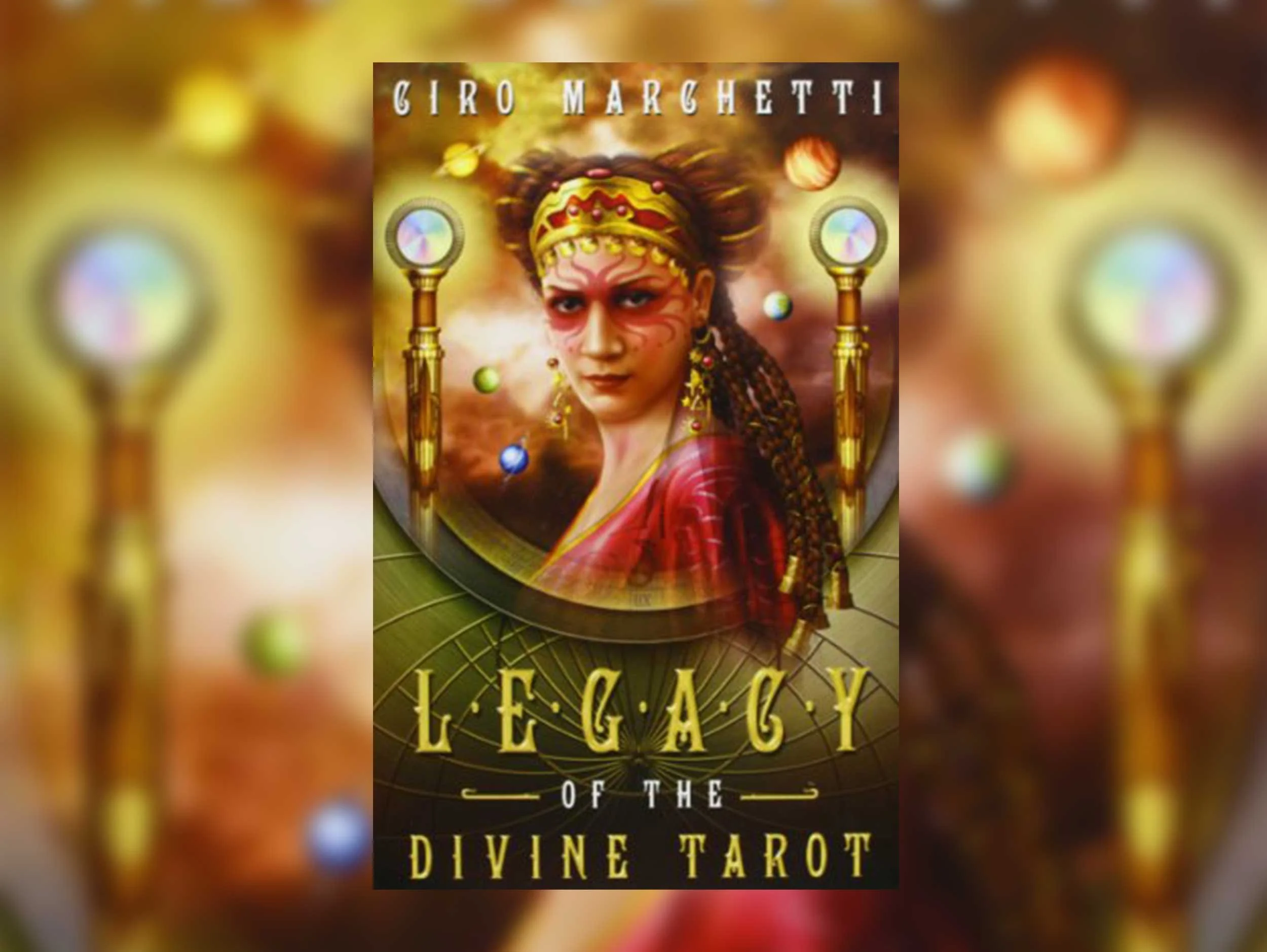
    The soon-to-be-completed third Tarot from artist Ciro Marchetti is sure to be the most meaningful Tarot of his career. It is also, according to him, likely to be his last. He met with me in his home in Boynton Beach, Florida one Tuesday afternoon to discuss his new project, entitled Legacy of the Divine Tarot.

    Marchetti has always collected and admired Tarot art, but has never been a Tarot reader. He’ll be the first to tell you that when he designed Gilded Tarot he knew next to nothing about Tarot symbolism. As he showed me some images from Legacy of the Divine Tarot it was clear that Ciro Marchetti has grown significantly in his understanding of Tarot symbolism and spiritual imagery.

    Legacy of the Divine Tarot is being worked completely on a Mac Digital Tablet. When I look at the facial expressions of the Tarot characters, the details in the images and the very realistic flora and fauna, I am shocked that this is done in pixels rather than in paint. Marchetti explained to me that it is not only his own evolution that will make his third deck his very best, it is also evolution in technology that allows him the finer control of a digital pen, rather than a mouse.

    Being in the Marchetti residence is rather like being a character in one of his Tarot decks. Everything is beautiful, and carefully placed to create a sense of both expansive space and cozy comfort. There are mechanisms, hot-air balloons, masks, water fountains and lush plants, just like in all three of his decks. I could see that Ciro Marchetti is the best kind of artist, one who real puts the essence of his own identity into his work.

    Ciro Marchetti’s second Tarot work, Tarot of Dreams, is revolutionary for a couple of reasons. First of all, for a self-published deck, it is selling incredibly well. Secondly, and more importantly, Tarot of Dreams is sold with a CD in which the Tarot absolutely comes alive. In Tarot of Dreams, Marchetti combined the ancient Tarot with modern technology to create a perfect blend.

    Legacy of the Divine Tarot will also be revolutionary. After spending considerable time researching Tarot history and symbolism, Marchetti, although never before a writer, was inspired to write the accompanying book rather than relying on a Tarot author as he had in the past. Furthermore, he made up a “back-story” for his new Tarot. He even created a dynamic video to introduce the Tarot and tell the story. The video is available for viewing on Vimeo at http://vimeo.com/1076456. The link is also on his website, http://www.ciromarchetti.com.

    The story of Legacy of the Divine Tarot is similar to the legend of Atlantis. A race of people, foreseeing their demise, left this Tarot for us as evidence of their culture and spiritual knowledge. This Tarot, then, is the legacy of their divine knowledge.

    There have been many Tarot decks that tell the story of a race or culture, or that use mythical icons to represent the archetypes of the Tarot. I’m thinking about Ancestral Path Tarot, Lover’s Path Tarot and Mythic Tarot, to name a few. There are far fewer decks that use a made-up mythology as a theme. In fact, modern Tarot historians have spent a great deal of time and energy to dispel myths about the history of the Tarot. I am sure that some of them will not be pleased with this newly invented Tarot myth. There will be others who will think that it is brilliant.

    The TarotL History Information Sheet speaks positively about new Tarot mythology; as long as we are do not confuse our myths with historical reality. To me, it seems that myths regarding the end of civilizations are themselves archetypal. People tell stories, too, about how their own civilizations may eventually end. Something deep within us is concerned about our own legacy, and about the legacy of those who have come before us. It makes sense, then, that a story-telling tool of archetypes such as the Tarot might inspire such an imaginative story about its own origins.

    Aesthetically and functionally, the mythology of Legacy of the Divine Tarot will not likely intrude on the beauty or readability of this deck. Much more than his earlier Tarot works, this new deck uses symbolism that is easy to read and understand. Many of the cards are reminiscent of the Rider Waite Smith images, though none of them are a direct copy.

    The Major Arcana cards are traditionally named and numbered. The images are meaningful, and instantly recognizable. There is a great deal of creativity in this deck, even beyond the beautiful artwork. The Empress is young and pregnant, surrounded by animals and plants. The Fool is distributing Tarot cards throughout the universe, in keeping with the legend that Marchetti created for the deck.

    The Minor Arcana cards promise to be just as rich, and just as easy to identify, as the Major Arcana. The Court characters that Marchetti showed me are particularly engaging, as are the other images of people throughout the deck. All of the faces in this deck show perceptible feeling. All of the landscapes are detailed and three-dimensional. All the colors are striking.

    Ciro Marchetti plans to finish Legacy of the Divine Tarot by the end of this year. He will self-publish a special limited-edition version of the deck that will be available on his website. A regular edition will follow, although Marchetti is not yet sure who the publisher will be.

    As he talks about this Tarot project, Marchetti is clearly excited. Over the years, he has developed an appreciation for Tarot readers, and for what Tarot reading is all about. One of his hopes for this deck is that people will get really good readings with it. As I look at the images of the deck in progress on Marchetti’s computer, I believe we will.