Month: November 2026

  • Sun and Moon Tarot Review

    Sun and Moon Tarot Review

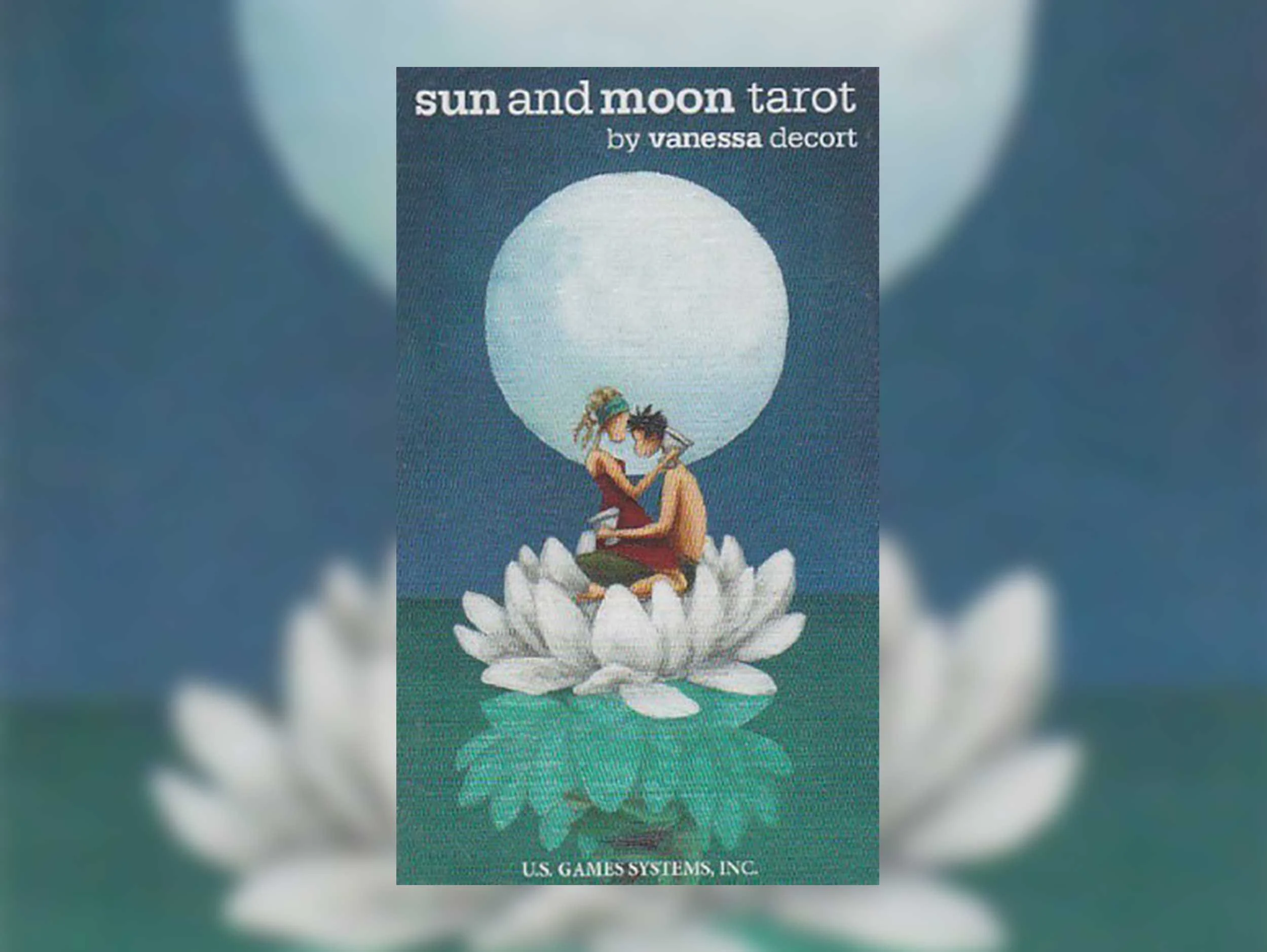
    Sun and Moon Tarot
    By Vanessa Decort
    Published by US Games
    Review by Christiana Gaudet © 2010

    The title, Sun and Moon Tarot, conjures celestial images, thoughts of outer world versus inner world, masculine and feminine, and, of course, two Major Arcana cards. In looking through the deck, it is unclear to me why it is so titled. There don’t seem to be any obvious references to celestial bodies, light and dark, God and Goddess, or inner and outer worlds.  The deck does have a sense of universality; we are all different, and yet all one. Perhaps that is what Vanessa Decort was trying to convey with her heavenly title; that we are all the same under the sun and the moon.

    Unlike many tarot artists, Vanessa Decort is both a tarotist and an artist. Her first introduction to tarot was the Crowley Thoth Harris deck.  According to the deck’s accompanying materials, Decort designed the deck “to deepen her understanding of tarot’s messages”. It was her goal to incorporate in Sun and Moon Tarot “universal archetypes and symbols from many cultures”.  

    The colors of Sun and Moon Tarot are lovely and the images are evocative. This deck is like no other I have seen, and yet it is grounded enough to make it serviceable and understandable. While there are many tarot decks available, there are very few that are both unique and truly usable. Sun and Moon Tarot is.

    The cards are standard sized, and have a plain white border. The card titles are on the bottom, in the border. There are no capital letters; all words on the cards and the box are lower case. .Numbers are written out in the card titles; there are no roman numerals. New students will enjoy the ease with which they can identify each card, even the pips, by name.

    Sun and Moon Tarot honors both Waite and Crowley. The Crowley keyword for each pip card is boldly printed in the top of the white border.   The images themselves are often reminiscent of Waite images. Justice is card eight, and Strength eleven, as in Crowley’s deck. Major Arcana fourteen is called “art-temperance” and twenty is called “the aeon-judgment,” melding the Crowley card names with the Waite card names. The Court is comprised of Princesses, Princes, Queens and Kings, but the Kings are pictured riding steeds, as Knights normally would.   The backs are reversible but no reversed meanings are included.

    Sun and Moon Tarot people are shaggy, baggy, dreadlocked folk of many skin tones. They have no distinct facial features. They are dressed in cargo pants, stripes and layers.  In fact, they are dressed like the young adults you might see at an art opening, a drum circle, or on the way to Burning Man. This is adorable in some cards, meaningful in others, and ludicrous in a few. The Emperor, for instance, in his striped tee shirt and sneakers, needs to do his homework, take out the garbage and stop playing video games. Well, that’s what happens in my mind when I see him dressed and slouching like my fourteen-year-old son.

    Many of the characters and images seem small, set against immense backgrounds; skies, moons, walls, oceans and fields that are often monochromatic and always textured. Occasional metaphysical “symbols from many cultures” sometimes fit well, and sometimes seem contrived and out of place. Some of the trees and costumes may have been inspired by Tim Burton and Amy Brown.

    As in many tarot decks, the people in Sun and Moon Tarot are often accompanied by animals. The deck loses some favor with me in that many of the animals are so cartoon-like that they just seem silly. Perhaps they were inspired by anime and Spongebob; things I am just too old to understand.

    Despite the monkeys and alligators, the Major Arcana is really brilliant in a lot of ways. The Magician is a Rasta dude with a djembe on the beach. The Moon has lighthouses for its two towers. Death is called “death-rebirth” and pictures a phoenix. The High Priestess is powerful and ethereal.

    The Minor Arcana uses Swords for air and Wands for fire.   The elemental triangle is placed at the top of each card, just below the keyword. The icons of the suit do not appear in each image. The Minor Arcana cards are not as detailed as the Majors. In some cases it is hard to see how the Crowley keyword fits with the image. In other cases it makes an interesting point.

    For instance, the Ten of Pentacles is “wealth”. Here we see a couple (he’s wearing a hoodie, she’s barefoot in a billowy dress) hugging each other with a tree between them. They each have their faces pressed against the tree. This neatly represents family legacy, being grounded to the earth, and the Kabalistic Tree of Life. That is a nice depiction of true wealth, better than the typical castle and coins!

    Sun and Moon Tarot is youthful, fresh and casual.  I had thought perhaps it would be more appealing to younger readers and clients. I tested that theory at a tarot study group, and found that age played no role in determining which tarotists would fall in love with this deck. I also discovered that some readers rejected the deck on first view, and then began to appreciate it after spending some time with it.  Sun and Moon Tarot kind of grows on you.

    The deck is packaged in the classic US Games box with a little white book, also written by the artist. I love it when artists write about their own decks.  However, Decort’s little white book is a little bit irritating. It may have been limitations of space, language or skill that caused Decort to feel complete sentences were optional in her card interpretations.

    Not everyone will appreciate Sun and Moon Tarot. The fifty-year-old in me wants capital letters, realistic animals, complete sentences and appropriate dress. The professional reader in me wonders how clients will react to boldly written keywords like “failure” and “debauch.”  But my inner tarot intellectual thinks this is a smart, workable and unique contribution to modern tarot.   And my eternal, ageless, timeless inner child is delighted by Vanessa Decort’s Sun and Moon Tarot. 
  • A Review of the Movie Eat Pray Love

    A Review of the Movie Eat Pray Love

    I have to admit I never finished reading the book Eat Pray Love. So many friends and clients recommended it, and a few gave me copies. The book’s biggest fans, I found, fell predominately into two categories; women who were self-reflective and women who were self-absorbed. In my limited downtime, I prefer easy-to-digest brain candy like a good sci-fi or mystery.

    I did, in the snippets I read, get a sense of Liz Gilbert’s humor. I wonder what she said, or thought, when the great Julia Roberts was cast to play her in the film adaptation of her best-selling memoir. That is probably my biggest take-away from the new movie. If you can have a spiritual transformation and write a great book about it, Julia Roberts might play you in the movie. What more could a girl want, really?

    If you don’t enjoy the movie Eat Pray Love, and many people won’t, it’s because you don’t need its message. If you find it trite, and may will, it is because you have yet to suffer in the quest for your own identity. Eat Pray Love is the story of a woman’s journey to Italy, India and Bali. But really, it is the story of her journey to herself.

    Set against an international backdrop, Eat Pray Love offers a view of American neurosis.  In Italy, Liz commits to eat without guilt, and to learn “the sweetness of doing nothing.” This is a valuable lesson for those living in the pressure cooker from which Liz was lucky to escape.

    In India, Liz stays at an ashram, and in finding God, begins to find herself. While there, she is promoted from floor-scrubber to hostess, learns to meditate, and is befriend by a recovering alcohol from Texas.

    An early scene in the movie depicts Liz, while in Bali on a writing assignment, getting her palm read by a medicine man. His prediction is a guiding force for her journey, which concludes, as he had predicted, back in Bali. 

    It is in Bali that the love part of Eat Pray Love happens for Liz. Here, she learns that she can find love without losing herself. Or a least we hope she does. The movie ends pretty quickly thereafter. We will have to read Elizabeth Gilbert’s new book, Committed, to discover what happens in her marriage to Felipe, the Brazilian from Bali.

    God is a central character in this movie. Much discussed in Liz’s voice-over narration, God is clearly not the Angry Sky Daddy of the Abrahamic religions. God is the international, inclusive God of the “Spiritual but not Religious.” God is the God of yoga, palm reading, kirtan and meditation.

    Eat Pray Love is directed by Ryan Murphy. I didn’t realize who he is until I got home from the premiere and read some reviews online (mostly bad). Ryan Murphy is the creator of Glee; trite, sugar-coated, larger-than-life, message-y, highly entertaining Glee. Ah, now it all makes sense.

    I was smugly pleased to see a magazine article recently saying that Glee was under some fire from conservative Christians for its moral messaging. I am sure that same group will find fault with Eat Pray Love, where God is found not in a church, nor in a book, but in oneself.

    Eat Pray Love is a visually stunning movie. The soundtrack, like the movie itself, was aimed directly at my middle-aged female self, with snippets of Fleetwood Mac and Neil Young. The casting and acting were decent, although this is not the first time we have seen Julia Roberts cast as a woman afraid to love. Eat Pray Love just misses being The Runaway Bride Goes to Bali by a smidgen.

    As I walked out of the theatre with my friends from the Awesome Mixers Social Activities Group, I had two things that stuck with me. I mean, besides the part about wanted Julia Roberts to play me when I write my memoir.

    The first was from a scene early in the movie. Liz is helping change her friend’s baby. Liz wonders when her friend knew she wanted to be a mother. We can tell Liz is conflicted about the idea for herself. Her friend pulls a box from under the bed, and shows Liz that she has been collecting baby items for years, simply waiting for the right time to have the baby she had always wanted.

    Voice-over Liz tells us that she has a special box too. Only hers is filled with travel guides and brochures. It made me wonder, do I have such a box, either metaphorically or literally? What’s in it?

    The second thing was about words. In Italy, Liz and her friends suppose that each city might be represented by a single word. New York, for instance, was “ambition.” People, too, could be represented by a single word. Liz’s search for identity became a search for her word.

     The title itself, Eat Pray Love, divides neatly into the three places Liz spent time. But it wasn’t just that Liz ate in Italy, prayed in India and loved in Bali. It was that in Italy, she learned to eat. In India, she learned to pray. And in Bali, she learned to love. 

    You don’t need to take a year-long international trip to make a spiritual journey, unless perhaps you are a professional travel writer like Elizabeth Gilbert. But the spiritual journey, by its very nature, involves learning. So if I were to title the memoir of my spiritual journey with three things I had learned, what would my three words be?

    Eat Pray Love is a chic flick. See it with your introspective girlfriends and bring some tissues. Leave the menfolk at home. Enjoy the feel-good afterglow in meaningful conversation over several glasses of wine. If you have the wine beforehand, there is a chance you might fall asleep.

  • An Evening with Ciro Marchetti, Tarot Authors and Artists Series

    An Evening with Ciro Marchetti, Tarot Authors and Artists Series

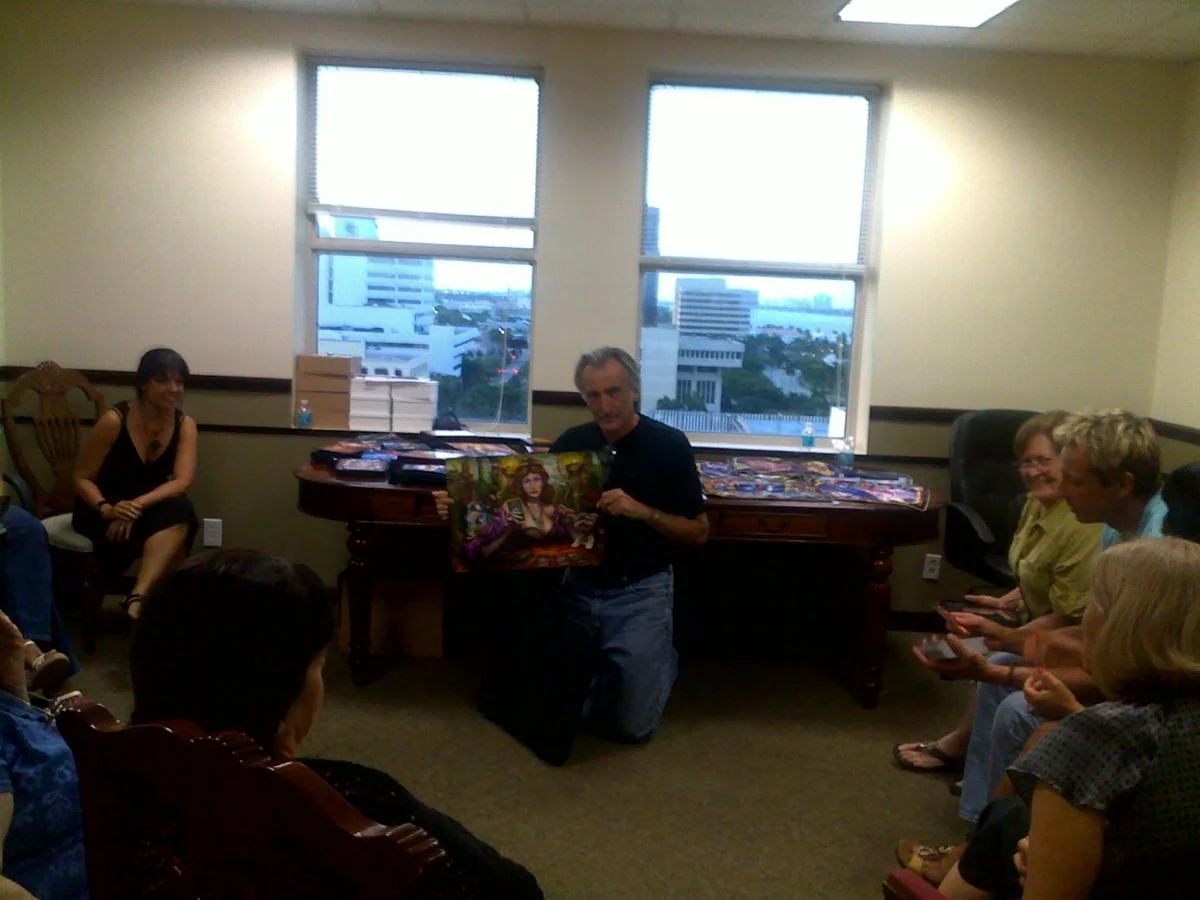
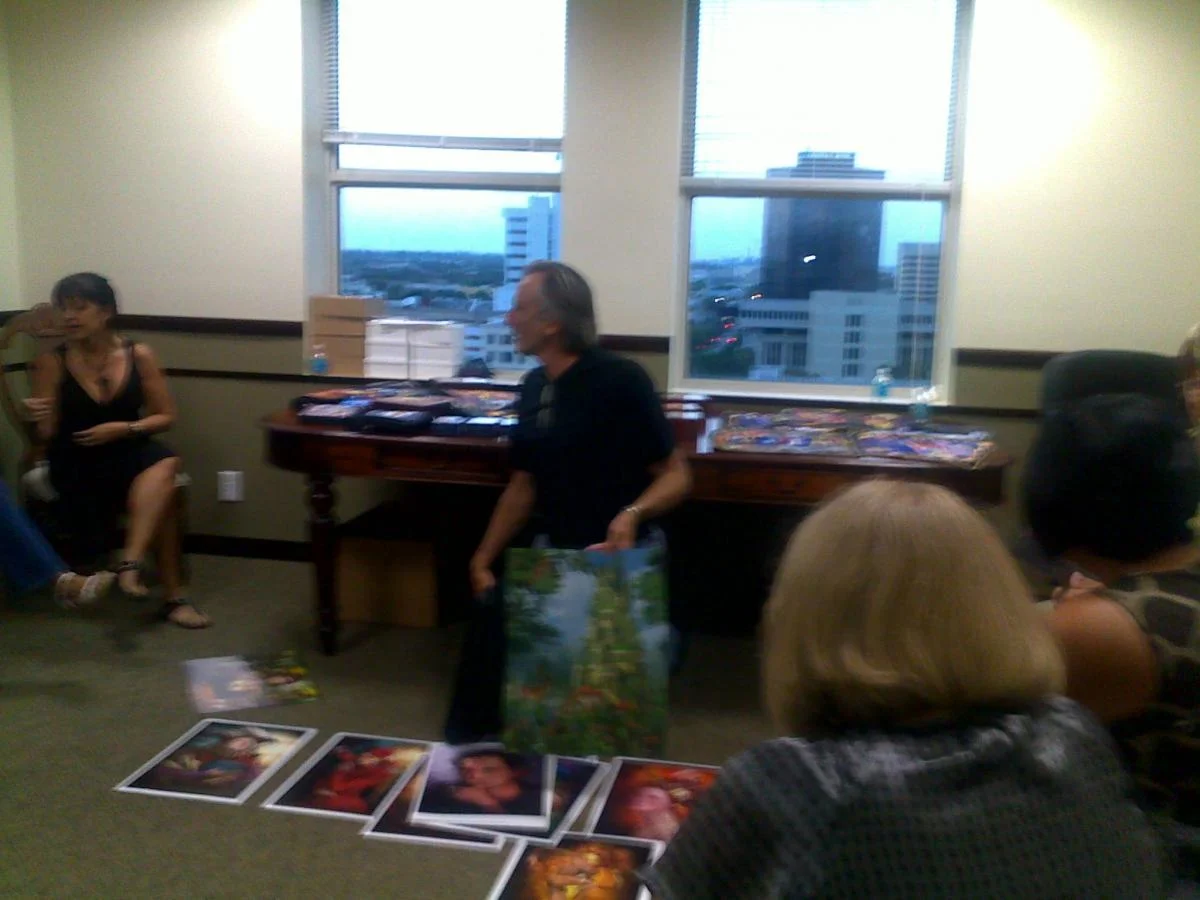
    On May 26, 2009 the Tarot Circle Meetup of the Palm Beaches was pleased to hold the second in our Tarot Authors and Artists series. This time our Tarot Author and Artist was South Florida’s own Ciro Marchetti.

    I am always amazed at just what a talent hotbed South Florida is. Whether it’s food, sports, music, dance, art, or even, specifically, Tarot, South Florida has the best of the best.   And that’s what Ciro Marchetti is; the best of the best.

    Ciro has recently published his third and final Tarot deck, the Legacy of the Divine Tarot. It was his goal that this be his best deck, and it is. That’s not to say that the first two, Gilded Tarot and Tarot of Dreams, were not delightful, or meaningful. But Legacy of the Divine is certainly a masterpiece. Rich in symbolism, it has real thought and creativity behind it, and pays homage to more traditional Tarot images in really respectful ways.

    Ciro Marchetti considers himself neither a spiritual person, nor a Tarot reader. His entrance into the Tarot world came as an artistic challenge. Now that he is solidly entrenched here he is able to offer some witty and sardonic observations of our community.  Sometimes it takes fresh eyes, an objective opinion, or an outside view to get perspective. In his presentation to Tarot Circle, Ciro gave us a view of ourselves, as well as a view of the Tarot.

    There are two stunning things about Legacy of the Divine Tarot, besides its amazing artwork. One is the myth that Ciro has created around it, and the other is its animated, interactive app for IPhone and IPad, now available from the ITunes Store.

    While enjoying the informal and captivating presentation, I discovered that Ciro’s take on Tarot history is similar to my own. We both find it suspicious that the only evidence ever given in defense of the myth of Tarot’s Egyptian origins is psychic.  For instance, we know that the Tarot originated in Egypt because we channeled an entity that told us so. Or, we know that the Tarot originated in Egypt because, well, it just feels true.

    Ciro went on to say that not only did he find the Egyptian story improbable; he found European Tarot history dry and unsatisfying. I think that a lot of us feel that way. But while using Tarot in storytelling and telling stories about the Tarot are common themes in modern Tarot study, none of us have done as Ciro has done.

    Ciro has created a myth describing an otherworldly culture; wise, spiritual, intellectual, and aware of its imminent demise. His Tarot is literally the legacy of this doomed culture. It tells the story of this culture’s rise and fall, and within it is preserved all of this culture’s esoteric wisdom.

    Prior to its publication, the Legacy of the Divine Tarot starred in a promo video that let us all know just how amazing this deck was going to be. But that short video did something else as well. It brought the Tarot characters to life. 

    When I teach Tarot Magick, I instruct my students to enter the card, and to become part of the action. Or to meditate on the card, and see how the characters move and interact with their surroundings. Giving the cards dimension and motion, and putting ourselves into the action, is an amazing tool of Tarot understanding. Creating video for the Tarot cards was a stroke of inspired genius that will help new generations of Tarot students understand and experience the cards even more deeply in this way.

    Those in attendance were thrilled to be amongst the first humans to see the Legacy of the Divine Tarot app, which was released to the public just a few days after his visit with us.   In the app, each card comes alive with movement and music.   Each card has some key words listed for it, and some of Ciro’s thoughts for each card, although he does not call them “interpretations.” We, as readers, will interpret the cards. He, as artist, will only describe them. To me, that feels like both a respectful distinction and a beautiful Tarot partnership between artist and reader.

    A couple of years ago, Wald Amberstone of the Tarot School in NYC asked me how I felt about the possibility of computer Tarot readings replacing me in my job of Tarot reader. I felt then as I do now, that a computer can display the cards, and display some possible interpretations, but a computer can never “read” the cards.

    While Ciro’s Tarot app certainly performs Tarot spreads, he made it very clear that he in no way intended the app to replace a living reader; only to be a tool for one. And what a tool it is! With this app, as we saw in the presentation, one can create a custom spread, perform the reading, make notes about the reading, save the reading, and even email it to a client or friend. And I had just decided NOT to get an IPhone. Hmmm . . . Perhaps this Tarot card reader sees an IPad in her future?

    Always respectful of the Tarot, Tarot readers, and the Tarot community, Ciro talked a lot about “pushing the Tarot envelope.” One of our members, Adrienne Percival, compared him to the Dyson of vacuum fame. In her review of the evening she said, in part, “As I listened to you describe how you would challenge yourself on each project to create something innovative and new, I was oddly reminded of Dyson.  I stand in wonder at how he took such ordinary, everyday tools and has completely revolutionized them.  Likewise in a field of 200,000 decks of cards each fitting neatly into their box, along comes your movie or your CD and explodes beyond the comfortably expected box”. That’s well said, Adrienne.

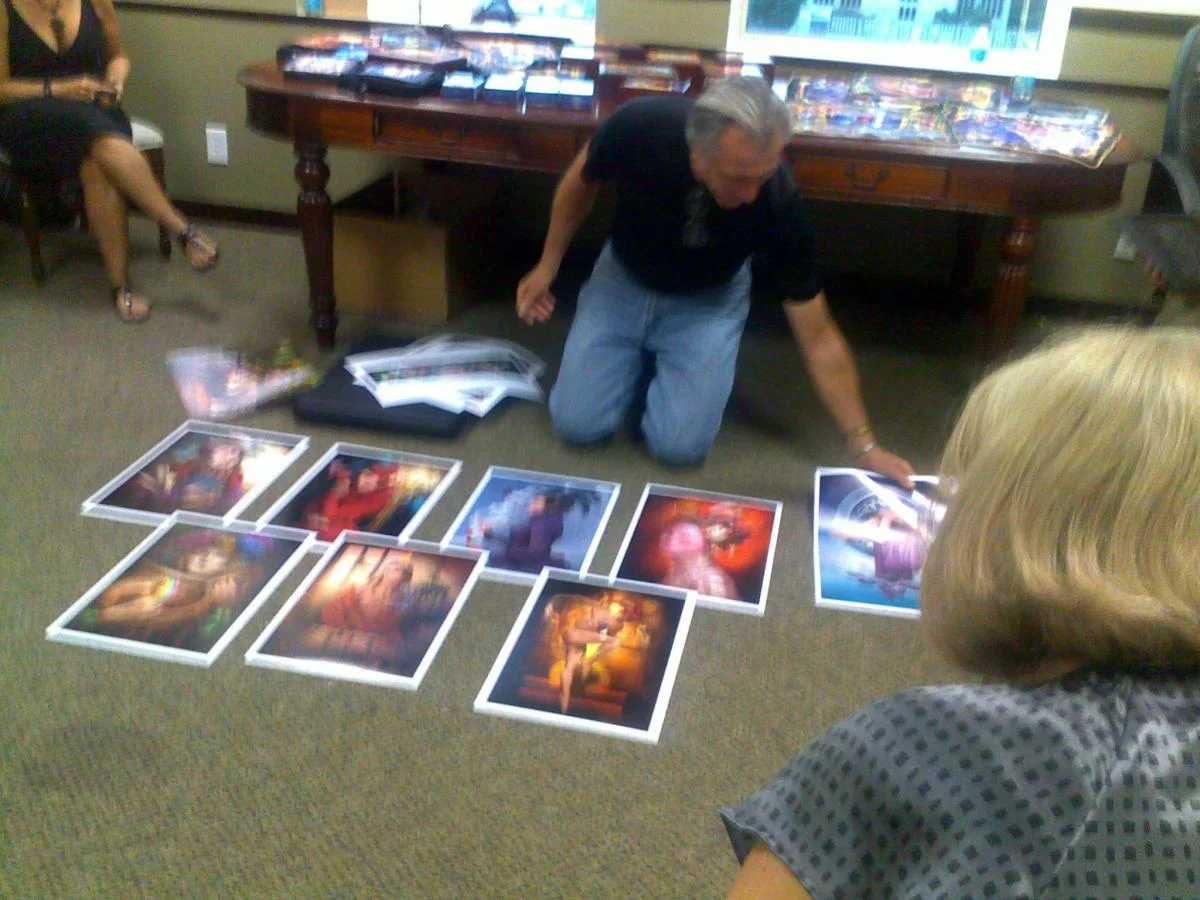
    While Legacy of the Divine Tarot is his last Tarot deck, it is not his last deck of divination. Ciro is now hard at work on his Oracle deck, whose working title is “Oracle of Visions.” He brought some large prints to show us, and let us know a little bit about its structure.

    Everyone knows I don’t like oracle decks. For me, if it ain’t Tarot, it ain’t worth it. I must say, though, that this deck has caught my eye. One of the images really spoke to me in a way that was visceral.

    It’s a smart deck, too. For example, a card that depicts a sense of being stuck includes in its image a chess game at check-mate. Each image has those kinds of interesting details, indicative of Ciro’s many talents and interests.

    Ciro and his gracious wife, Maria, arrived with enough goodies for us all to have a nice shopping experience. They are also pushing the Tarot envelope when it comes to the kind of merchandise they are producing. Amazing Tarot boxes and Tarot pouches are great, so are the altar clothes. But have you ever seen a Tarot purse?  The shoulder bags are as yummy as they are affordable. Check them out, along with Tarot decks, prints and other great stuff, at http://www.ciromarchetti.com. And, don’t forget your Legacy of the Divine Tarot app at the ITunes Store!

    Tarot Circle Meetup of the Palm Beaches is grateful to Ciro and Maria Marchetti for sharing their time, stories, talent and ideas with us!

    Return to Essays

  • A Review of The Pamela Colman Smith Commemorative Set

    A Review of The Pamela Colman Smith Commemorative Set

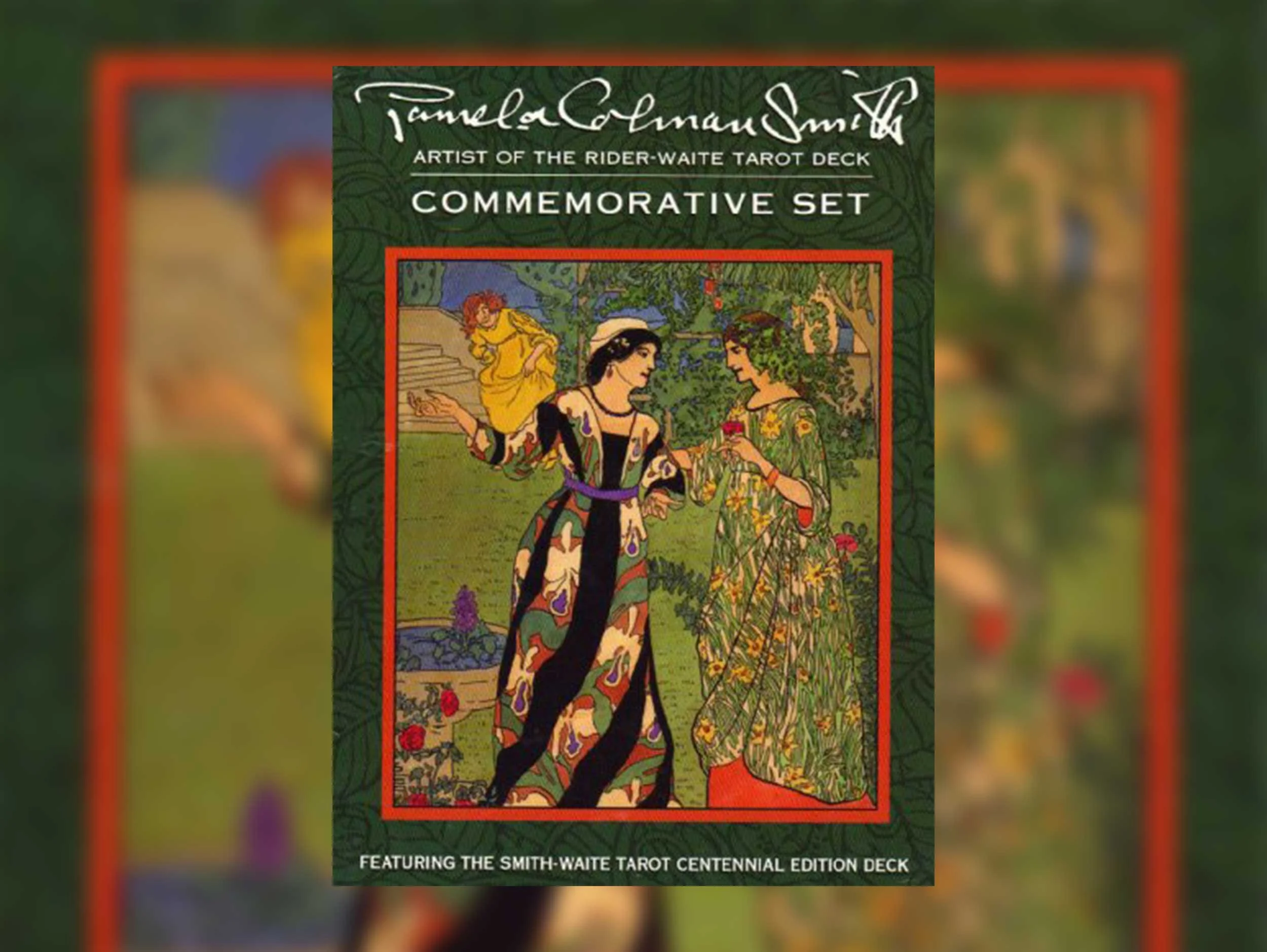
    A Review of the Pamela Colman Smith Commemorative Set
    Featuring the Smith Waite Tarot Centennial Edition Deck
    Published by US Games
    ISBN 978-1-57281-639-8

    There are more tarot decks based on A.E. Waite’s designs (and Pamela Colman Smith’s artwork) than any other tarot model.

    There is the Rider Waite, the Golden Rider, the Universal Waite, the Albano Waite, The Original Rider Waite, The Radiant Rider Waite, and so on.

    When we look at the Smith Waite Tarot Centennial Edition Deck, the first question we need to ask is this. Did the world really need yet another version of this deck?
    To me, the answer is clear. The world desperately needs this deck, and any reader who values Pixie’s humongous contribution needs it too.

    US Games released this set to celebrate the one hundred year anniversary of the publication of the Waite designed images. That they took this as an opportunity to honor Pamela “Pixie” Colman Smith is brilliant, and long overdue.

    Whether you are a new tarot student or an experienced reader, you may wonder why you should pay $35 for yet another Waite deck.

    First, the deck is only a small part of what is included in this special set. The set comes in an attractive box that opens up to reveal compartments on each side. One compartment holds the tarot deck. The other holds a wealth of amazing stuff, included a new edition of the Pictorial Key to the Tarot, and a wonderful book by Stuart R. Kaplan.

    Kaplan’s book is “The Artwork and Times of Pamela Colman Smith.” It is one hundred pages of color illustrations and stories about Pixie. We can see her handwriting, read her poetry, and learn more about the woman who influenced tarot so greatly. Pixie finally becomes a real person, rather than simply the talented puppet who rendered drawings for Waite. The book includes primary source material. It is graphically beautiful, and a pleasure to read.

    That same compartment holds other treats, including postcards of Pixie’s non-tarot artwork, and a tarot spreadsheet. This truly is an epic collector’s edition.

    The tarot deck itself is a masterpiece. Of course, we are familiar with the images, and with the structure of the tarot itself. A few things make this edition special, and make it my very favorite edition of this deck for professional readings.

    The cards are printed on very heavy stock. It is noticeably heavier than an average deck. It’s perfect for a collector’s edition! The deck stands taller than average decks when side-by-side. The weight of the stock does make the deck harder to shuffle. In all my years of professional reading, I have rarely developed calluses on my hands from sweating over the hot tarot cards. After using this deck as my primary reading deck for only a month, my hands had developed definite ridges. For me, this was kind of a cool badge of honor, although I understand that not every reader might appreciate it that way.

    The card backs are a light antique-looking blue with a white border. The white flower from Death’s flag is in the center. Pixie’s familiar initial logo is large and black in alternate corners. The logo does cause clients to ask, “What does that symbol mean?” A quick opportunity to educate an interested client about tarot is never a bad thing.

    The card images are re-colored in muted tones. There is a subtle texture, as well. Together, the tones and texture make the cards look antique, as if they had actually been made during Pixie’s time.

    In a way, I regret reading with my deck at all, since keeping this collector’s set in mint condition might have been wise. But these cards are just too tempting to keep on the shelf.

    My solution is to buy two sets. That way, you can send the postcards to your friends, or incorporate them in art or décor projects. You can read with the deck, use the books as reference, and still have a perfect set in your collection.

    That’s right, I am recommending this tarot set so highly, I think some folks will need not only one but two!

  • Vanessa Tarot Review

    Vanessa Tarot Review

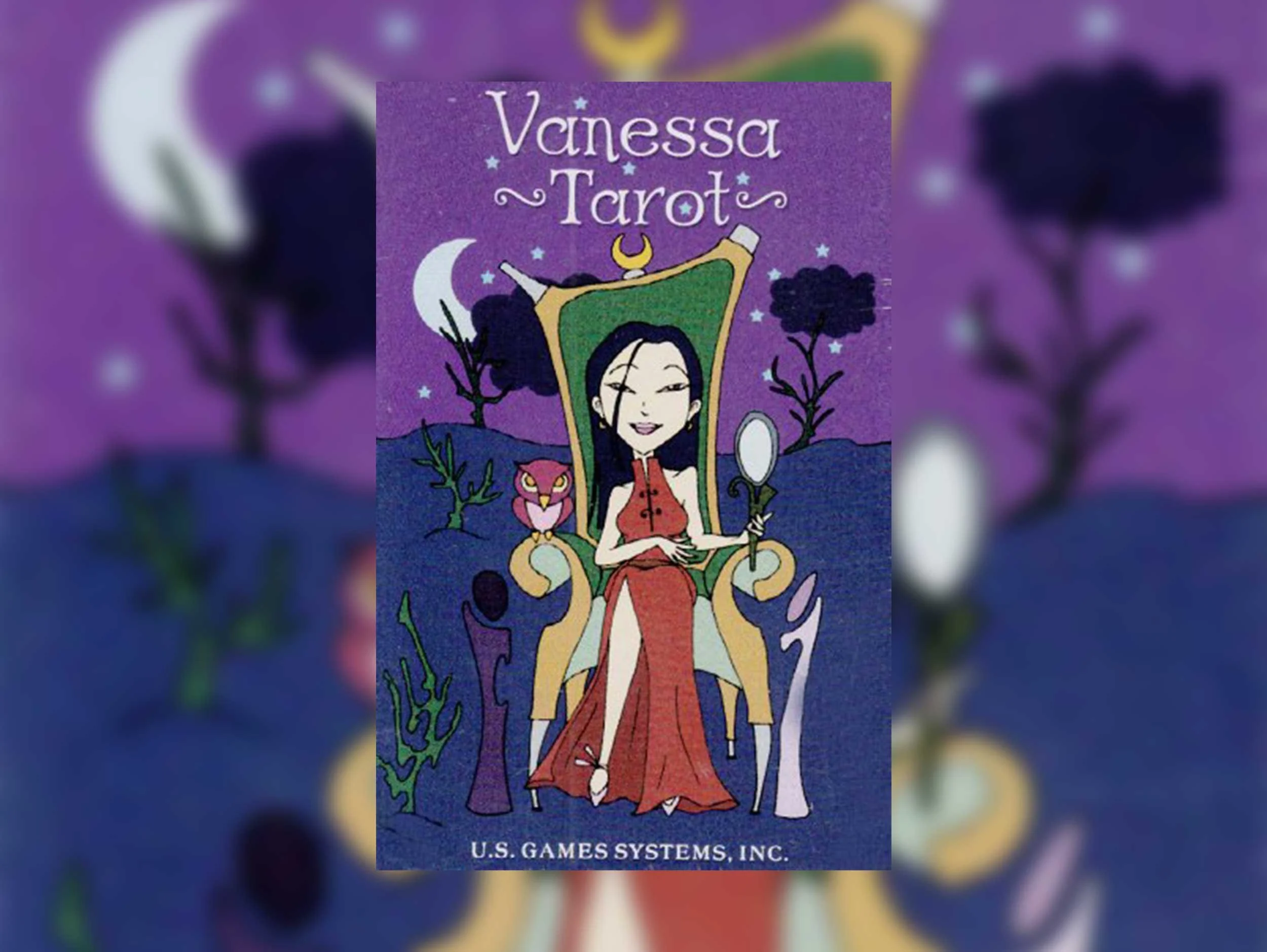
    Vanessa Tarot by Lynyrd Narciso
    ISBN-13 978-57281-574-2
    Published by U.S. Games, Inc copyright 2006
    Review by Christiana Gaudet

    I have to admit that I was somewhat reluctant when asked by Lynyrd Narciso to review his new Tarot deck, Vanessa Tarot. I had noticed it in the U.S. Games catalog and already written it off as yet other fluff deck. Certainly it was cute and kitschy, but not the kind of deck I would think would be worth studying or using for actual readings. Yes, I am most definitely a Tarot snob. But, at the same time, I am never one to turn down a free Tarot deck.

    When the Vanessa Tarot arrived in the mail, the first thing I noticed was that I really liked its tin box. What a good idea it is to package a Tarot deck in a box that can actually be used to carry your cards in your purse! And that is when I started to understand Vanessa Tarot’s real deal. Yes, this is exactly the deck to carry in your purse. And, if you are like the characters of this Tarot, your purse may be a Coach, a Louis Vuitton , or a khaki backpack or leather briefcase.

    I am in no way a designer girl. In fact, what I am is a crusty old Gloria Steinem-type feminist from the Seventies. But, as I looked through Vanessa Tarot that first time, I had to admit that this is really a special deck.

    Vanessa Tarot is smaller than most, measuring only about 2” by 3,” according to my thumb. The card backs are reversible, and done in a nice purple pinstripe with lavender stars. The cardstock has a matte finish, and is of the good quality that we have come to expect from U.S. Games. Overall, it is a nice deck to look at and to hold in your hands. For all of its great quality and special packaging, Vanessa Tarot retails at only $15. That, girls, will leave you some money left over to spend at the mall!

    Vanessa Tarot comes with a standard-sized LWB (Little White Book) that gives quick descriptions of the Major Arcana card images, and upright and reversed meanings for all the cards. The Minor Arcana is sorted by numbers rather than suits, and there is a paragraph about each number preceding the interpretations for the four cards of each number set. There seems to be no mention of the four elements, but from the pictures I assume the standard associations of Swords-Air and Wands-Fire could apply. The card names are standard, with a court of Pages, Knights, Queens and Kings. Strength is card Eight and Justice is Eleven.

    Each Vanessa Tarot card is illustrated with cartoon-like drawings of women and girls. There are some male figures in the deck, but they are supporting characters. Vanessa Tarot pays tribute to the girls and women of pop culture from today and yesteryear. Television and movie stars make an appearance, as do many “types” of modern women. There are business women, glamour girls and daredevils. They are all either pretty or cute, and all skinny. They are dressed in styles from many periods of fashion.

    The Minor Arcana cards are as detailed as the Majors, which is a feature I appreciate.

    The deck truly won my heart when I saw that my favorite TV character from childhood, Samantha Stevens (Bewitched, played by Elizabeth Montgomery) appears in her classic pose, sitting on her broomstick, as the Eight of Wands.

    The thing that truly bothers me is that the LWB doesn’t tell us which cards are which characters. I am pretty much a pop-culture drop-out, and haven’t watched TV in more than ten years. When I showed the deck to my twenty-two year old daughter, she recognized many more of the characters than I did.

    She felt that the Three of Cups may be the cast from “Charmed,” for instance. But nowhere in the booklet could I confirm that, or discover which other pop culture heroines had found their way into this cute-but-powerful little deck.

    I passed the deck around to many of my students. Overall, the reaction was positive. Many felt that this would be a particularly good “first deck” for our daughters. Even some of the more mature students liked it, especially those with an eye for glamour and fashion. One older student, whose favorite expression is “It’s all about the outfit!” was particularly taken with it.

    Another great thing about Vanessa Tarot is that none of the images are particularly dark or scary. This would be a great deck for some of the professional bookings that I often get, in nightclubs, at college parties and all-night high school graduation parties.

    And what about my crusty feminist self? Well, bear in mind that the second deck I ever owned was the Motherpeace, and I have a particular penchant for Goddess Tarot decks, such as the beautiful one by Kris Waldherr. But Vanessa Tarot, with all of its cuteness and glamour and designer-type fashion, is the only one I have seen that had the ovaries to make all four Kings female! Yes, all of the main characters are female. And they all seem pretty happy doing what they’re doing, whether it’s being dressed to the nines, keeping house or jumping out or an airplane. And if that’s not female empowerment, I don’t know what is!

  • The Nigel Jackson Tarot

    The Nigel Jackson Tarot

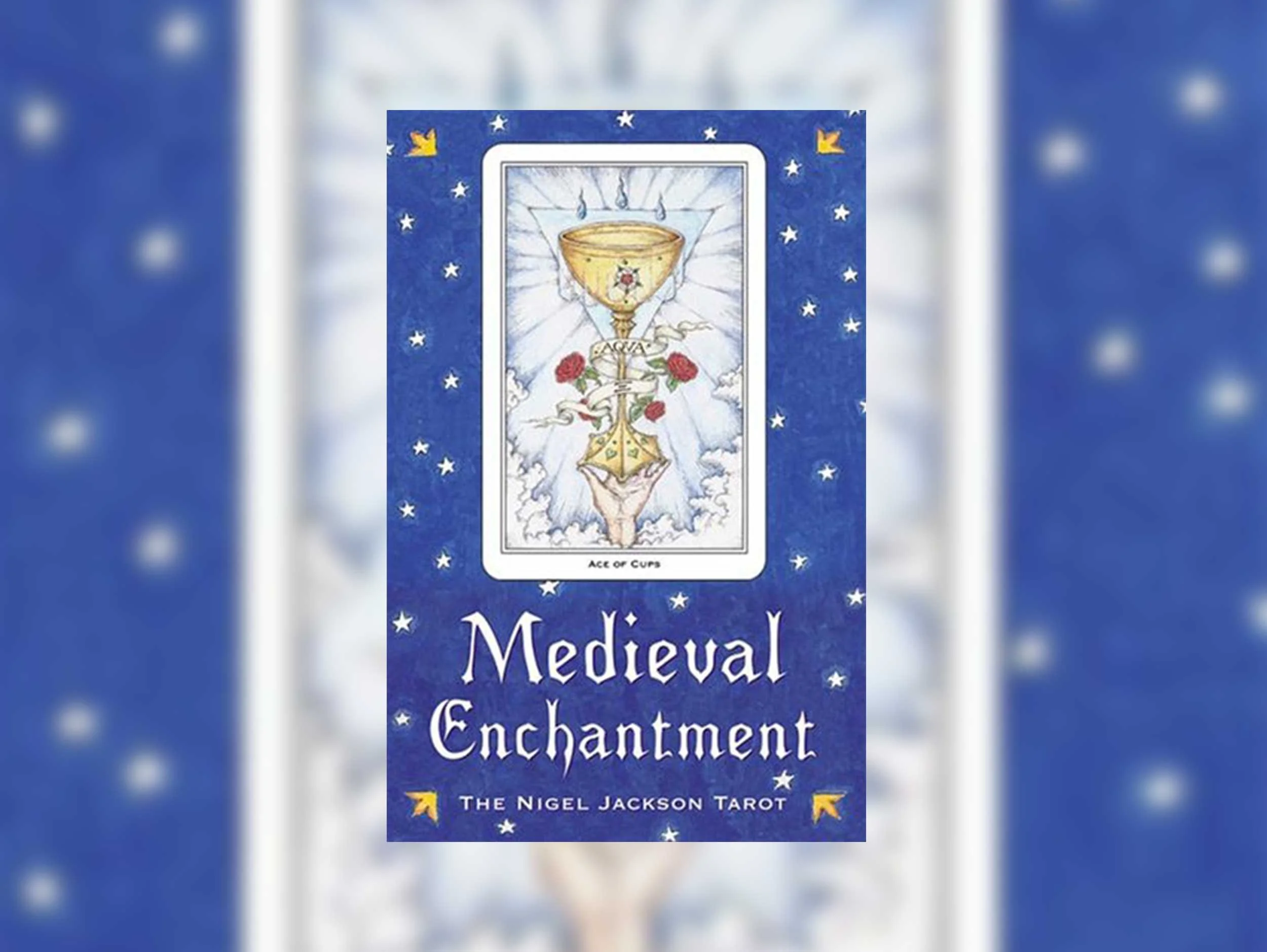
    Lewellyn Publications first published the Nigel Jackson Tarot in 2000. It was repackaged as Medieval Enchantment: The Nigel Jackson Tarot in the fall of 2004. It received an enthusiastic response from the tarot community because of its striking colors and evocative images. The Medieval images of the Nigel Jackson Tarot are a perfect blend with the Greco-Roman philosophy that influences the deck.

    The Nigel Jackson Tarot bears similarity to the world’s most popular deck, the Rider-Waite-Smith, in that each card is illustrated with simple but understandable pictures. It bears similarity to the ancient Tarot De Marseilles in the structure of the Major Arcana, and in that each Minor Arcana card has a clear depiction of the correct number of icons for its rank. It bears similarity to many modern Pagan decks in that Swords represent the element of Fire and Staves represent the element of Air.

    Nigel Jackson associates the Pythagorean numerology system to both the Major and Minor Arcana, which adds to the understanding of each card. The Nigel Jackson Tarot book also offers a special tarot reading method based on the Pythagorean system.

    The four suits of the Nigel Jackson Tarot Minor Arcana are Cups (Water), Coins (Earth), Swords (Fire) and Staves (Air). Staves are pictured as arrows, just are they are in ancient tarot decks.

    The Major Arcana of the Nigel Jackson Tarot uses some older Tarot traditions for naming and ordering the cards. Major Arcana 1is called the Juggler. Major Arcana 2 is the Popess, and Major Arcana 5 is the Pope. The Strength card is given the ancient name of Fortitude, and is ordered as Major Arcana 11, while Justice is Major Arcana 8.

    The recent thinking of the Tarot community is that there is no proof that occult knowledge was intentionally included in Tarot design in the Fifteenth Century. In his book, Nigel Jackson draws a convincing argument that the occult knowledge is clearly present, and that the Tarot is strong tool for magick, ritual, mediation and spiritual growth as well as divination.

    The divinatory meanings listed in the book are extremely traditional. As he discusses the spiritual meanings, however, he does so from a Gnostic perspective. This helps to explain the concept of Gnosticism, and gives a clear and spiritual explanation of the Path of the Tarot.

    The Nigel Jackson Tarot, now known as Medieval Enchantment, is an all-around terrific deck. While the artwork is neither detailed nor striking, the colors and images work perfectly to present the meaning of each card.

    This is a must-have for any student of numerology, Tarot history, or medieval occult thought. It is also a great deck for Tarot enthusiasts at any level of study, from beginner to professional.

  • Shadowscapes Tarot Sneak Peek Preview of a Deck Now Published

    Shadowscapes Tarot Sneak Peek Preview of a Deck Now Published

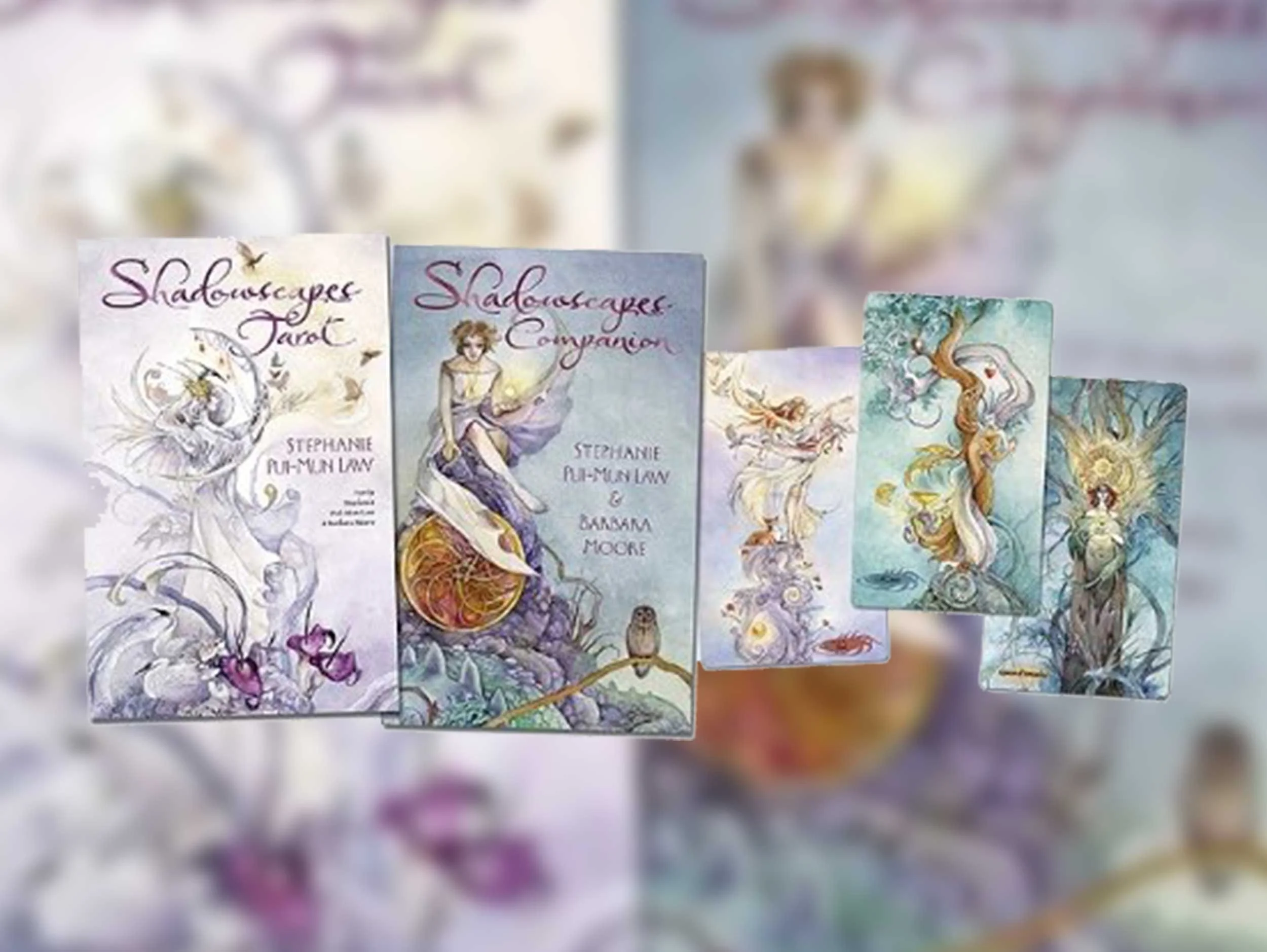
    Shadowscapes Tarot by Stephanie Pui-Mun Law
    Submitted to Tarot World Magazine by Christiana Gaudet

    Shadowscapes Tarot Deck (Shadowscapes Tarot, 2)
    By Law, Stephanie Pui-Mun, Moore, Barbara
    Buy on Amazon

    My recent telephone conversation with artist Stephanie Pui-Mun Law left me with an understanding of her forthcoming Shadowscapes Tarot, and an appreciation of what it is to be an artist.

    I have a fascination with Tarot artists. I wonder about the drive and commitment it takes to complete a 78-piece body of work. I think about the research needed to honor the ancient traditions, especially for an artist who has no real background in Tarot. I admire the imagination and spirituality it takes to add something new to the world of Tarot.

    Stephanie Pui-Mun Law has all of that and more. She approaches her soon-to-be-completed Tarot project with the systematic precision that made her a successful computer programmer in the past, and that gave her the courage to leave that behind and become what she was always destined to be; a full-time artist. As she said to me in our conversation and states on her website, “there is the part of me that just loves to draw and paint for its own sake. Forget meanings and high-minded interpretations…when it comes down to it, I just have a need to draw and create.”

    Pui-Mun Law defines herself as a fantasy artist. Like many modern Tarot artists she has a successful enterprise illustrating collectable cards games (CCG) and role playing games (RPG). Her credits include Warlord and Legend of Five Rings. She also designs jewelry and greeting cards, which are available for purchase on her website, Shadowscapes.com.

    Shadowscapes is the name of her website, and also the name of her Tarot deck. She defines Shadowscapes as something different from the fantasy work that she is commissioned to design. For her, Shadowscapes represent “a way of viewing something with a different mindset. Shadows of reality that are almost grasped, but at the same time dancing in a dream-world made of light and absence of light.”

    The Shadowscapes Tarot, which is now very close to completion, has in it many elements that are common to her fantasy work. Dragons, foxes, Celtic knotwork, mystical creatures and mythical beings are all a part of this Tarot.

    Painted in watercolor, this deck is ethereal, and not at all as dark as its name might imply.

    The images are somewhat non-traditional, but certainly easy to understand. The Fool is a beautiful woman accompanied by a fox, standing on the very edge of a pillar. Birds fly around her, holding in their mouths the ribbons of her gown. She is about to take the leap that begins her journey. The Wheel of Fortune is illuminated by beams of light, and is a colorful Celtic knot. Death is a flaming phoenix.

    Some of the cards on the website are accompanied by text that tells the story of the Tarot characters in language that is both fanciful and meaningful. When it is published, the accompanying book will surely be as much of a treasure as the deck itself.

    The Major Arcana follows traditional naming conventions, Strength is card 8 and Justice is 11. The Minor Arcana is also quite traditional in its format, though not in its artwork. Pui-Mun Law, in her systematic way, began by designing the Aces, and has worked her way through the Minor Arcana in numerical order. The only cards left to be designed are a few of the Court cards, which are traditionally named as Pages, Knights, Queens and Kings.

    Not all the Minor Arcana cards show the specific number of suit icons as more traditional decks do, but each card is identifiable as a member of its suit. Some Minor Arcana cards feature people, some feature only animals, and some include both people and animals.

    The suit of Wands has an almost desert-like quality, reminding me of a fanciful version of the African savannah. It is colored in reds and browns. Lions and foxes are prominent throughout the suit.

    The suit of Pentacles is colored in greens, blues and gold, and features dragons and lizards on some of the cards. It is perhaps not as grounded or earthy as I expect Pentacles to be, but I love that some of the Pentacle icons are drawn in Pui-Mun Law’s signature Celtic style.

    Cups, of course, are watery, and lend themselves beautifully to the expressive style of the deck. Icons are shown as bejeweled chalices or crystal clear fishbowls. Graceful fish swim their way through the blue, white and lavender cards.

    A wonderful thing about this deck is there are few truly disturbing images. The traditionally dark suit of Swords is illustrated in a contrast of rich and pale colors. Birds of all types grace this suit. While the Three of Swords does show a wounded Swan, the typically devastating Ten of Swords is an image of a woman falling through the air. The meaning is the same, but the image would be much more palatable for a timid client.

    And there I’ve said it. While Shadowscapes Tarot is definitely an art deck that collectors will swoon over, it will also be a serviceable reading deck for anyone who enjoys fantasy images and beautiful colors. It is a deck that will attract new students and seduce the clients of professional readers.

    To order art prints of the finished cards, and to order the Shadowscapes Tarot as soon as it becomes available, visit the website at http://www.shadowscapes.com.

  • Introducing the Lover’s Path Tarot

    Introducing the Lover’s Path Tarot

    “Tell me about my love life!” I think most tarot readers hear this request more often than any other question. Perhaps this is because love, romance and procreation are emotional and biological prime directives for us all. Perhaps it is because love between humans is one of the ways that divine power shows itself on earth. Perhaps it is because love and passion are the causes of great human suffering throughout history and all over the world.

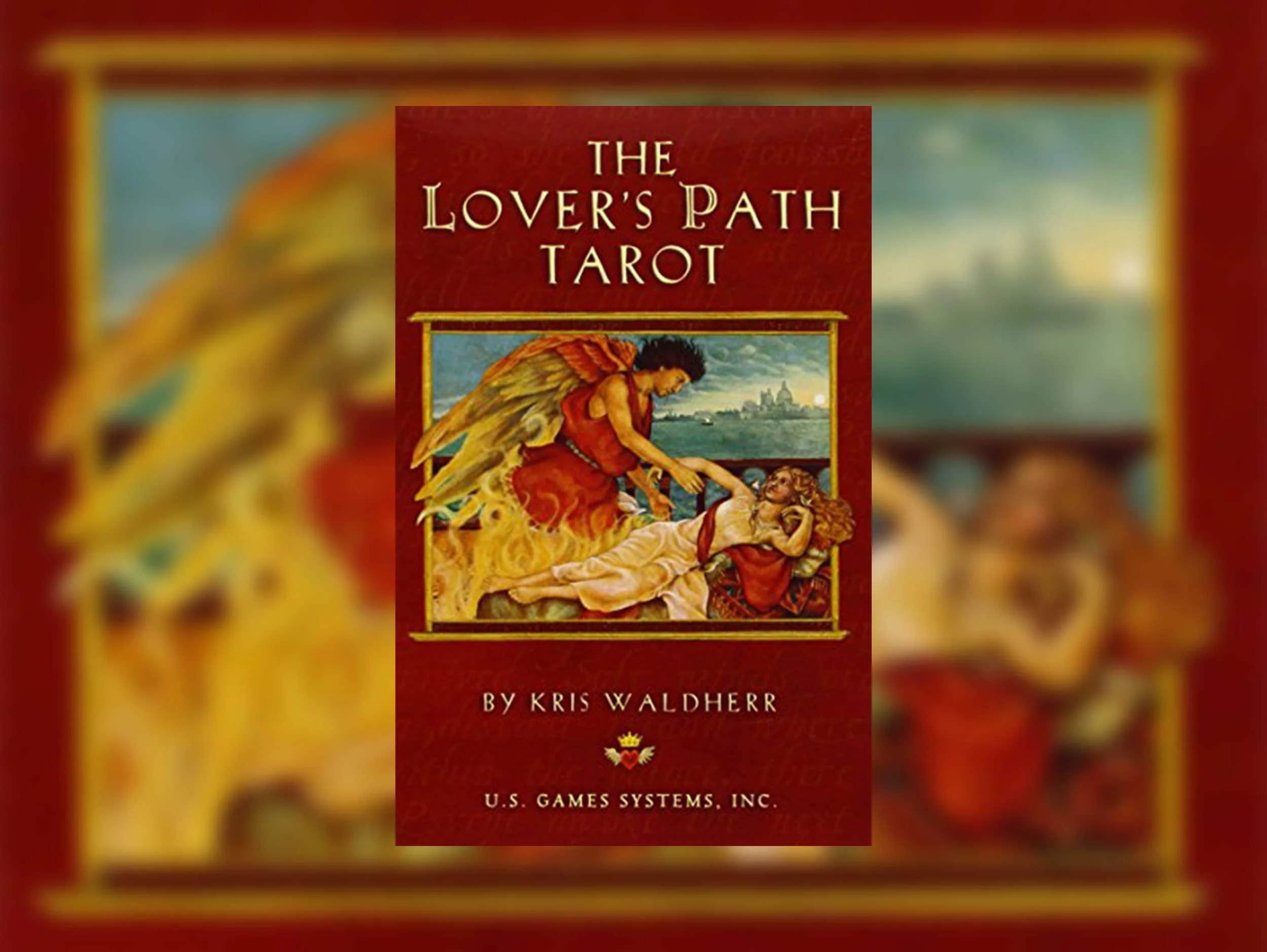
    From Kris Waldherr, author and artist of the Goddess Tarot, comes the Lover’s Path Tarot. This tarot set is specifically designed to address the question of love in our lives.

    Its packaging is luxurious and romantic; reminding us that romance is an energy we create around ourselves. Its stories remind us of the eternal joys and struggles of love. As it tells stories of lovers through time and mythology, it tells our own stories as well.

    A Storytelling Tarot

    All tarot decks tell a story. Typically, it is the story of the Fool, an Everyman sort of character, who experiences each tarot card as a lesson along the path of life. Recently man tarot artists and authors have used the storytelling nature of the tarot to depict stories from many cultures and times.

    The Ancestral Path Tarot uses each Minor Arcana suit to tell a story from a specific race of the human family. The Whimsical Tarot uses each card to depict a fairy tale or nursery rhyme. The Goddess Tarot assigns a particular Goddess and her mythology to each Major Arcana card, and to each suit of the Minor Arcana. The Lover’s Path Tarot is an ambitious story telling project. Each Major Arcana card is represented by a love story, as is each suit of the Minor Arcana.

    As tarot readers, we must all be storytellers. We must look at the cards as they are laid out and put the images together to tell the story of the querent’s life, or situation.

    A Teaching Tarot

    The point that Kris Waldherr stresses is that all our relationships mirror our relationship with ourselves. If we are out of balance, our relationships will be out of balance. If we treat ourselves badly, we will be in relationships with those who treat us badly, or with those we treat badly.

    In studying the Lover’s Path Tarot we have the opportunity to learn about the tarot, to learn about love stories throughout the ages, to learn about the nature of love, and, maybe most importantly, to learn about ourselves.

    The best way to use the Lover’s Path Tarot to help improve our relationship with self is to dialogue with the cards. Use the cards as a method of communicating with your higher consciousness, and let one answer lead to the next question. These methods are described in detail starting on page 124 of the Lover’s Path Tarot Book.

    The Lover’s Path Tarot Book

    The Lover’s Path Tarot Book is a wonderful resource. It contains details stories of the featured lovers, upright and reversed meanings for each card, techniques for reading, spreads and quick reference charts. It is a wonderful springboard as you begin a new relationship-your relationship with the Lover’s Path Tarot!

  • Introducing the Animals Divine Tarot

    Introducing the Animals Divine Tarot

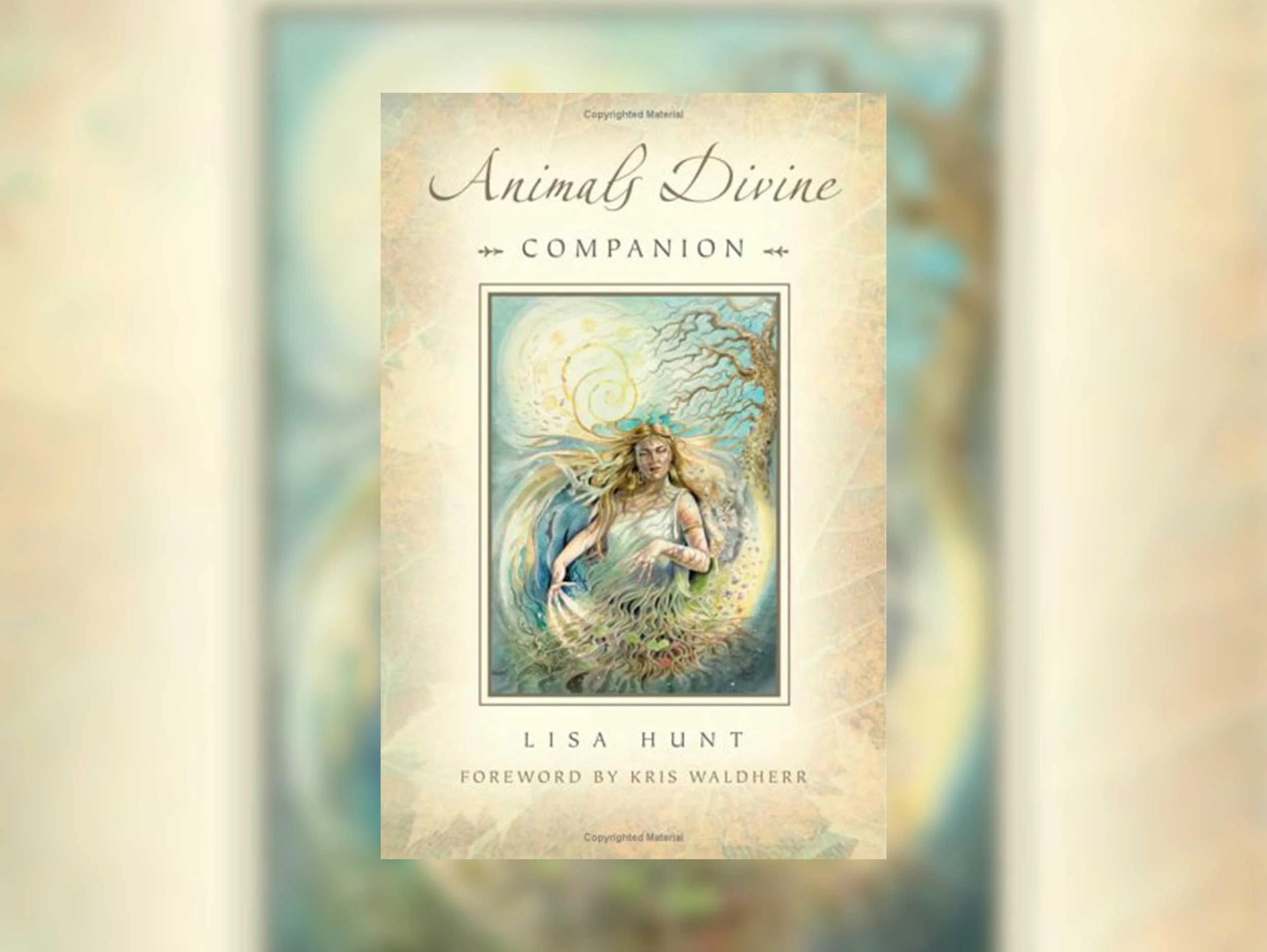
    The Animals Divine Tarot, by Lisa Hunt, was published by Llewellyn Worldwide in 2005. It is Lisa Hunt’s third Tarot deck, and the first that she has done as a solo project. It has already received awards and acclaim in both the art world and the Tarot world.

    Animals Divine proposes some specific and spiritual ideas. One is simply that all animals are our teachers. That by watching the traits and behaviors of animals we can find the easiest and best ways to deal with our own challenges. As we consider this concept we can easily take it a step further, to the concept that we all have instinctive and intuitive natural behaviors. If we can, like animals, access those core traits and behaviors, we will be living more in synch with our own nature, and with the natural world.

    That leads us to the second concept; that all life is part of a web, and interconnected. Each card in the Animals Divine Tarot somehow reminds us of the cycles and rhythms of life. The third concept is that all life is sacred, and that all life has a purpose. No life form should be considered inherently irritating or dangerous. Instead, we must respect and honor all creatures of the earth. As we approach Animals Divine, then, we must do it with a sense of reverence for all life, and a willingness to learn from even the lowliest creature, and to see that we are connected to all the creatures of the planet.

    The Animals Divine Tarot falls into three different Tarot categories. One is the category of Animal-themed Tarot decks, of which there are a countless number. Some animal Tarot decks focus on a specific animal, such as the Medieval Cat Tarot or Tarot of the White Cats. Others focus on mythical animals, such as the many dragon Tarots or the Unicorn Tarot. There are also decks that feature animals from a specific region or culture, such as the Australian Animal Tarot.

    Animals Divine Tarot distinguishes itself in three ways. First, it focuses on animals and animal myths and deities throughout the world. These images are universal, rather than limited to a specific species or region. Second, all the animal images are surrounded by symbols from their natural world. You will not find a leopard carrying a pocketbook, or a seal wearing clothing. You will find that each card is rife with symbolism that is well explained in the companion book. The symbolism is part of the natural landscape of each card, making each card a celebration of the natural world.

    The second category is one that I am calling “archetypal assignment” Tarot. In this type of Tarot deck, Tarot designers find elements within a particular group of characters and assign one to each Tarot card. They find a connection between that particular character and the standard archetype associated with the particular card. Characters that have been previously used include deities, mythical characters from a variety of cultures and even rock musicians. Tarot artists such as Kris Waldherr and Julie Cuccia-Watts join Lisa Hunt in making this type of Tarot a modern standard. It means that artists no longer need to rework the standard and familiar Tarot images, and are free to express those archetypes with other kinds of images. For instance, in Animals Divine, Major Arcana 12 is not an image of a figure hanging by one foot. Instead, it is the Hanged Woman who is the Spider Woman of Native American culture. She is shown weaving her web, rather than hanging upside down. This type of Tarot deck also reminds us that each Tarot image is an archetype, and that each archetype is present in every culture.

    The problem comes in when an artist assigns a particular character to a particular card in a way with which a particular tarot student may not agree. Students need to see their disagreement with an assignment as a valuable teaching tool. With assignments that you don’t like or don’t understand, spend some time puzzling it out. The artist’s assignment may give you a new way of understanding the particular card. The time you spend thinking and meditating on it may increase your own understanding of the card.

    Archetypal assignment Tarot decks are particularly good decks to help us increase our understanding of Tarot as a whole. Some Tarot students feel that they offer more spiritually-based readings, rather than readings that predict specific events and discuss mundane issues. Overall within the Tarot community there is a move away from the “fortune-telling” aspect of Tarot and a move toward a more meditative and spiritual use of the cards. Archetypal assignment decks are part of that trend.

    Thirdly, Animals Divine Tarot is most definitely a Pagan Tarot. There are many Pagan, Shamanic and Wiccan decks on the market. What separates Animals Divine from the pack is that you don’t need to be Pagan to use it. Yes, it offers a world view that honors all life. Yes, it suggests that nature is sacred and is our sacred teacher. It even honors the Pagan deities of many cultures. It admonishes us to be better stewards of our planet. But it does not preach a particular religious structure or practice beyond that.

    Animals Divine is a valuable study tool for the serious Tarot student, a wonderful tool of spiritual discovery for anyone who honors nature, and a solid deck of divination for those seeking answers to life’s many questions.

  • Introducing The Tarot of Transformation

    Introducing The Tarot of Transformation

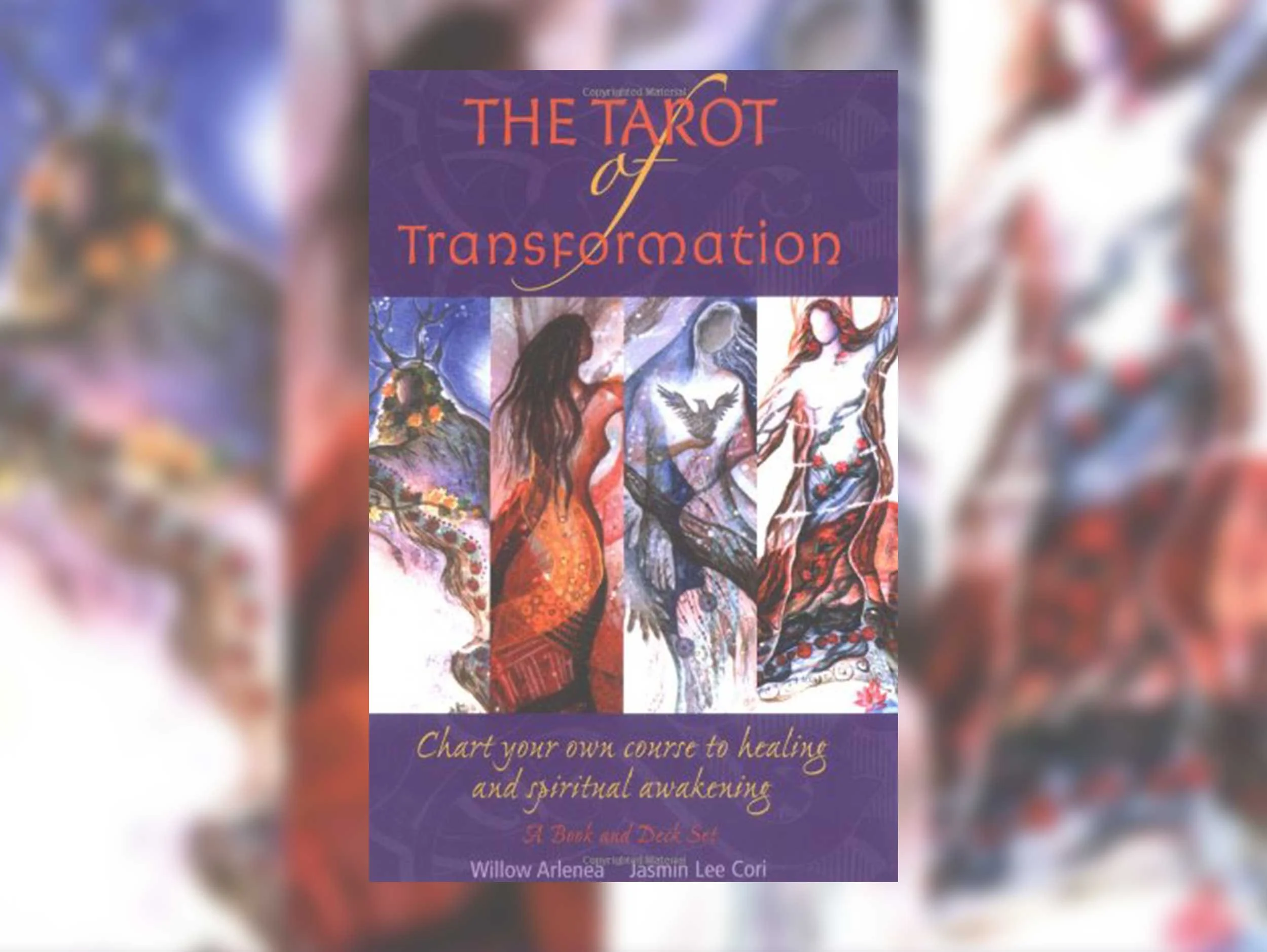
    Many Tarot decks are designed with a specific purpose. Some are meant to honor a particular art form, or are centered around a particular design theme. Some use the traditional archetypes of the Tarot to express a particular spiritual practice or tradition.

    The Tarot of Transformation is based on the idea of personal transformation, as well as the transformation of our global community.

    Each card helps us, as members of a global community, to focus on achieving a better ecological balance for our world, and a healthier mindset for our society.

    As individuals dedicated to personal growth, the cards serve as a guide toward personal transformation.

    In most cases, the authors of the deck do stay within the archetypal idea of the traditional Tarot, even if the images and key phrases are very different. Students of the traditional Tarot will enjoy using this deck to help them expand their understanding of the ancient archetypes.

    If the Tarot of Transformation is your first introduction to the Tarot, it is best to understand that this modern deck is a very special evolution of a time-honored tradition. In its early roots, the Tarot was, admittedly, sexist, classist and hierarchical, reflecting its medieval origins.

    Many traditions of Tarot reading have been removed from the Tarot of Transformation. For instance, the authors have chosen not to interpret reversed cards. Instead, we are invited to see both an up and a down side of each card, and intellectually or intuitively decide which energy best suits our present circumstances.

    Likewise, large spreads using many cards are discouraged. Each card bears such an important message that it needs to be digested and understood without the clutter of too many other cards around it.

    The artwork of the Tarot of Transformation invites meditation. Each picture can draw you in until you become a part of the image, and allow the image to speak to you directly.

    The Tarot of Transformation book is well–written. Unlike many tarot books, it does not put a greater importance on Major Arcana cards than Minor Arcana cards. Each card is given a long description. Many card interpretations suggest personal exercises or meditations to help in your journey toward transformation.

    The book also suggests that being cognitively drawn to a card is as important as pulling a card at random. However a card comes to you, it is important to understand its message to you, and how it can help you transform your life, your community and your planet.

    The Tarot of Transformation is a personal tool for meditation, healing and growth. It is also a tool to be shared with friends, family, and community. It is not intended to predict the future or answer mundane questions. Instead it is a spiritual and psychological tool. The Tarot of Transformation is uniquely designed to give you insight and to help you connect with your highest source of personal power.

    The artwork of the Tarot of Transformation is very abstract, and its color theme is purple. The cards are larger than average, but that seems necessary to give room to the complex detail of each image. My only complaint about this deck is that the cards seem cheaply made and are printed on thin stock. However, when I got my review deck I did stress-test a few cards and they held up just fine.

    This is a great deck for people who enjoy card oracles but are not huge Tarot enthusiasts, because each card can read like an oracle card. It is also great for people who enjoy abstract meditative artwork, students of transpersonal psychology, and people who want to explore the Tarot as a tool of spiritual and psychological transformation.

    In professional readings, I use it as an adjunct to a more traditional deck. When I am stumped on a particular issue, or when a problem needs greater clarification, I bring out the Tarot of Transformation, fan it across the table, and ask the client to pick a couple of cards. I jokingly call this process “Bringing out the Big Guns.” It really does seem to work to bring a sense of clarity and understanding to a particularly complex reading. It is nice, too, that none of the images or card names are threatening or negative. Even if the message is severe or intense, it is given in a kind and loving way.

    The Tarot of Transformation is a great tool for a daily one-card reading, dream interpretation, Tarot magick, meditation, and for developing a deeper understanding of the Tarot as a whole.